AI-Driven Growth Intelligence System
See what your marketing is leaving on the table
- 1Find the growth gaps.Paid media, creative, tracking, conversion paths, market position, and AI visibility are read together.
- 2Turn scattered signals into one plan.Ad Prophet connects account evidence, market context, customer behavior, competitors, and owned content.
- 3Prioritize the work that can move revenue.The output separates forecasted priorities, test-ready ideas, directional signals, and items to hold.
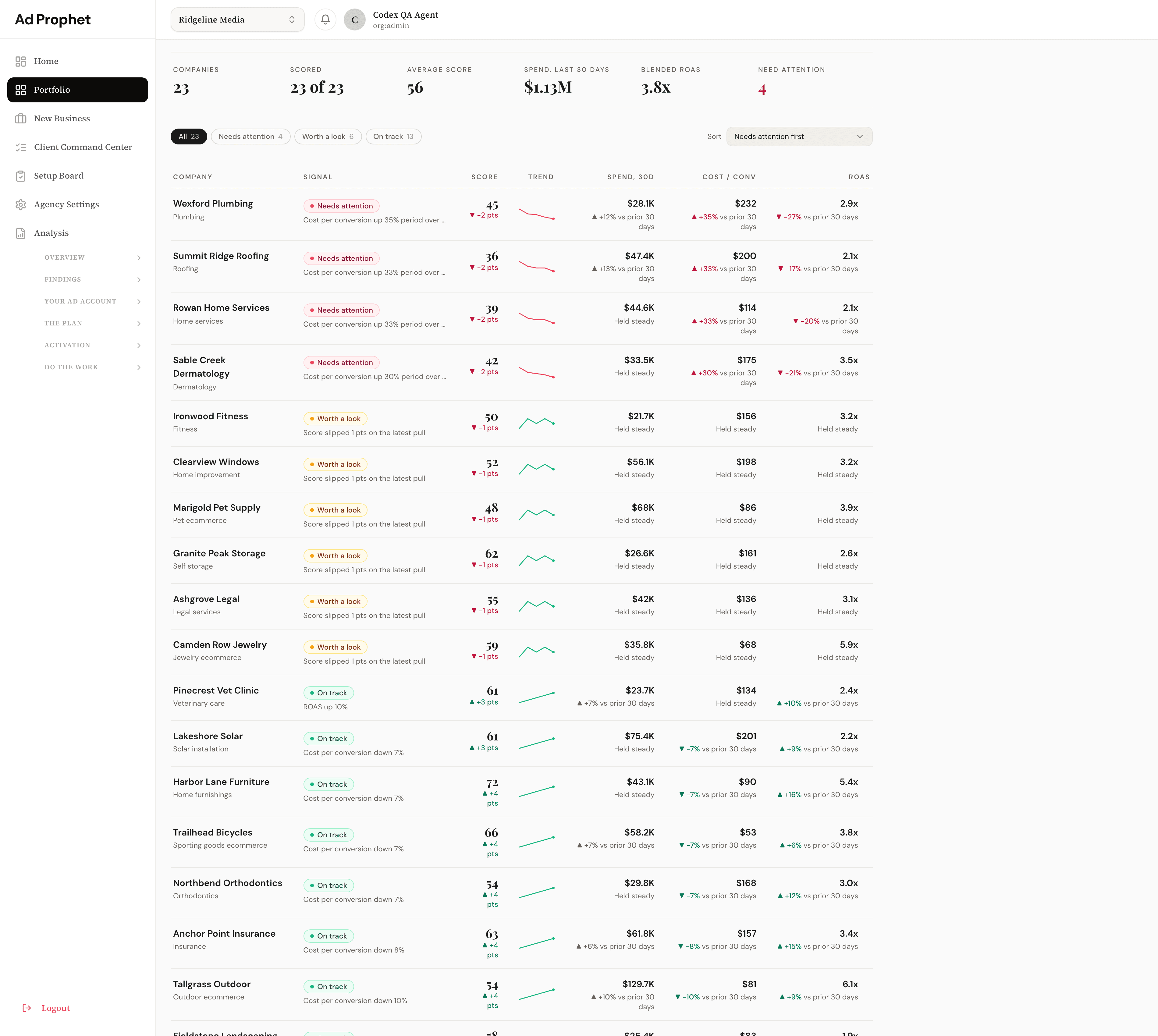
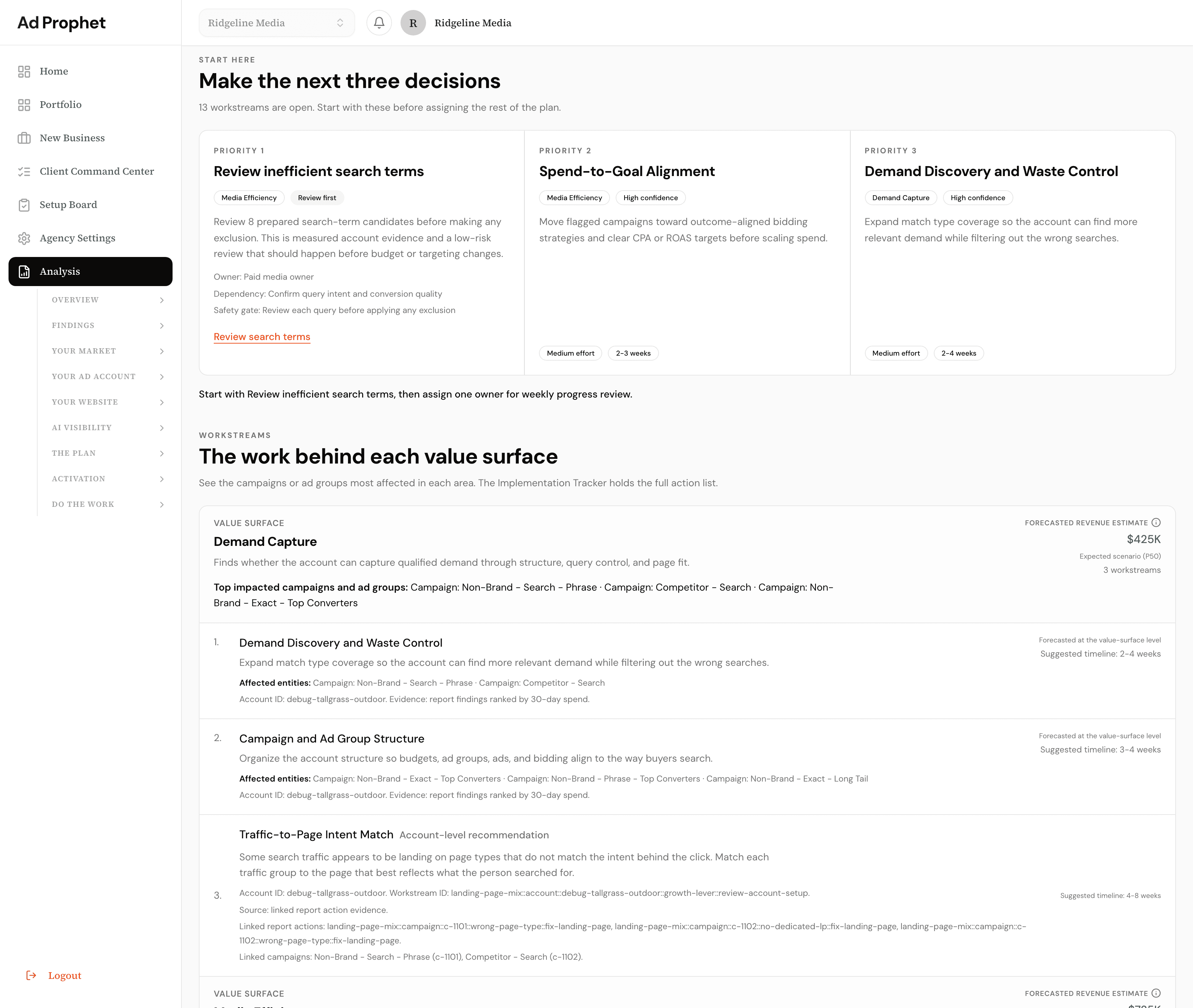
See the connected view: account score, forecast, AI visibility, ranked actions, and audience insights.
Signals
2,600+
Account, market, competitor, and creative inputs.
Priority
Ranked
The work ordered by what should matter first.
Output
Launch plan
Campaign, landing-page, and creative work to ship.
Evidence themes
A wider read before a sharper plan.
The assessment looks across account data, buyer behavior, competitors, owned content, tracking, creative, AI visibility, and business context. We group the sources into a few themes so the output is easy to use.
Google Ads depth
2,600+
Account checks across structure, search intent, spend, conversion quality, tracking, and page fit.
Source coverage
10+
Source families can feed the assessment, then get grouped into clear business themes.
Output
Ranked plan
The final view separates what to fix, what to test, what to monitor, and what to hold.
Account and tracking evidence
What the account says
Google Ads structure, search intent, conversion quality, tracking gaps, budget pressure, and page fit.
Market and buyer evidence
What the market says
Customer behavior, public demand signals, reviews, objections, competitor pressure, and category expectations.
Creative and content evidence
What the message says
Owned pages, proof language, creative angles, landing paths, AI visibility, and source authority.
Forecast and action evidence
What the team should do
Priority areas, expected impact, confidence labels, workstream sequence, and reforecast timing.
What you receive
Not an audit. A forecasted growth plan your team can act on.
Each report connects source evidence to business impact, then separates what should be fixed now, what should be tested, and what should not be forecasted yet.
Source proof
Growth thesis and source proof
See which signals support the plan, which assumptions need testing, and which claims should stay out until there is enough proof.
Forecast map
Forecasted upside by workstream
Understand the priority areas that may be worth the most, the assumptions behind them, and the order they should be tackled.
Ranked worklist
What to fix first
Campaign, keyword, query, ad, tracking, and landing-page issues ranked by what should be inspected or changed first.
Buyer proof
Personas ranked by evidence
Buyer types, triggers, objections, proof points, and message hooks ranked by the strength of the evidence behind them.
AI visibility
AI answer visibility and trust map
See where answer engines mention the brand, where competitors show up, what gets cited, and what content should be built next.
Creative kit
Creative tests and activation path
Persona-led storyboards, landing-page angles, test objectives, sequencing, and reforecast timing.
Evidence to workstream
Every recommendation points to a lever, a test, or a waitlist.
The value is connecting what the evidence shows to what the team should do next, then labeling whether the work is forecasted, test-ready, directional, or not ready yet.
High-intent terms outpace page fit.
Search demand is ready, but the landing path is too broad for the promise in the ad.
Route intent to best-fit page paths.
Map terms, ads, and pages by buyer problem before adding budget.
Demand capture
Tracking gaps weaken confidence.
Some events need cleanup before the team should trust the forecast range.
Fix conversion quality before scaling.
Improve signal quality, then reforecast once cleaner data comes in.
Tracking
Review language shows proof gaps.
Buyers ask for trust, comparison, and value proof before they are ready.
Build proof blocks for comparison shoppers.
Turn buyer questions into page modules and ad tests.
Test-ready
AI answers miss the brand.
Answer engines do not consistently cite the brand for important buyer questions.
Build citation-ready pages and schema.
Improve the pages AI systems can find, trust, and cite.
AI visibility
Campaign Story Map
Buyer stories your team can actually test.
Each lane shows the persona, hook, evidence used, landing-page angle, test objective, and the confidence level behind it.
Fictional sampleLane A | Highest confidence
Routine Simplifier
Busy household decision maker
Lead with a simpler daily routine, clearer proof, and a lower-friction first step.
Evidence used
Convenience, proof gap, page angle
Fictional sampleLane B | Test-ready
Caregiver Confidence
Supportive family researcher
Make trust visible for buyers helping someone else choose, especially when the decision feels personal.
Evidence used
Review language, trust signals, decision support
Fictional sampleLane C | Directional
Proof-First Shopper
Comparison shopper
Use evidence, pricing clarity, and proof blocks before asking the buyer to convert.
Evidence used
Competitor pressure, value proof, test objective
Forecast confidence
Some findings get a forecast. Some become tests.
Forecasted
Enough evidence to model
Used when spend, intent, and conversion data support a range.
Directional
Useful signal
Important, but more proof is needed before forecasting.
Test-ready
Clear enough to launch
Ready for ads, creative, landing pages, or messaging tests.
Wait
Interesting, but not ready
Tracked until there is enough proof to justify time, budget, or a forecast.
Why it is different
Built for judgment, not just access.
Account access, AI tools, and manual audits can all be useful. Ad Prophet gives the work a repeatable operating system so teams can compare evidence, rank the work, and rerun the baseline after changes launch.
Direct AI or MCP access
Access alone does not create judgment.
A connection can expose account data. Ad Prophet adds the scoring system, source checks, confidence labels, and ranked plan that make the data useful.
Manual agency audits
Useful work should be repeatable.
Manual audits can surface good ideas. Ad Prophet gives teams a consistent way to check more inputs, compare findings, and rerun the baseline after changes launch.
Internal analysis
Teams need a cleaner starting point.
Internal teams already know the business. Ad Prophet organizes the evidence so operators can decide what to fix, what to test, and what to hold.
How it works
Start free. Go deeper when the signal is real.
The first read is free and does not require Google Ads access. The full assessment is the paid engagement that connects account data and turns the read into a ranked plan.
Free first read
Start without account access
Share light, non-confidential context. Ad Prophet gives a first read on market, positioning, and competitor signals before asking for Google Ads access.
Paid full assessment
Connect the account when there is enough signal
If the first read shows a real opportunity, the full assessment adds Google Ads evidence, ranks the work, models the upside, and turns it into a plan.
Step 01
Start with light business context
Share non-confidential context. No Google Ads access needed yet.
Step 02
Get the first read
See the market, positioning, and competitor clues worth checking.
Step 03
Connect Google Ads when the opportunity is real
Add account data to rank the work and model the upside.
Step 04
Receive the ranked plan
Get the forecast, worklist, and buyer stories to test.
Who it is for
Built for teams that need sharper growth decisions.
For brands
$30K+/month in Google Ads
Find what to fix first and what it may be worth.
For agencies
A stronger audit starting point
Give strategists a sharper evidence base.
For Private Equity / Investors
A clearer view of growth quality
See where paid growth may be constrained.